European pension funds consider financial risks of climate change
Bild: Pixabay
Mercer research reveals that 17% of European pensions schemes are considering financial impact of climate change. This is a three-fold increase from those surveyed in 2017. Regulatory nudges are encouraging investors to consider the physical and policy risks posed by climate change.
Mercers 2018 European Asset Allocation Report reveals that more European pension funds are considering the investment risks posed by climate change. Seventeen percent of the 912 participants in Mercers 2018 survey stated that they now consider the investment risks posed by climate change, up from 5% in Mercers 2017 survey and 4% in 2016. This more than triple increase comes as NASA has confirmed that April 2018 was the third warmest April since modern record keeping began in 1880.
The 2018 survey the 16th edition gathered information from institutional investors across 12 countries, reflecting total assets of around 1.1 trillion. In addition to investment strategy information, the report also explores the drivers behind Environmental, Social and Corporate Governance (ESG) integration and a few key areas within responsible investment: investor stewardship, active ownership rights and finally, the investment risks and opportunities posed by climate change.
Increased engagement due to regulatory nudges According to Phil Edwards, Mercers Global Director of Strategic Research, "Nudges by the UKs Pensions Regulator, the EU Commission and the Financial Stability Boards Task Force on Climate-Related Financial Disclosures (TCFD) are driving increased engagement. However, at 17% of respondents, there is further to go in terms of serious investor engagement on this issue. We expect the industry-led approach of the TCFD to continue to drive awareness of the issue."
Kate Brett, Principal in Mercers Responsible Investment Team, said: "A proactive approach to consideration of environmental issues can open up investment opportunities in the green fields of the low carbon economy, while inactivity by pension schemes brings risks from stranded assets and physical climate risks, as well as reputational risk. Given increasing regulatory involvement and public concern about climate change, it may be that in time a lack of consideration of ESG risks will be seen as a breach of fiduciary duty. We continue to work with our clients to help them integrate consideration of ESG within their decision-making processes."
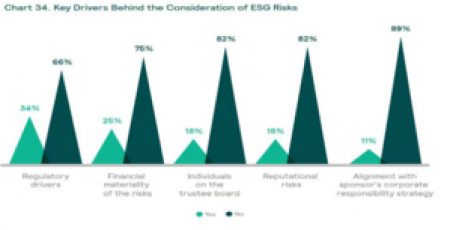
Mercers 2018 survey (See Chart) found that 34% of survey participants cited regulatory drivers as the key factor in encouraging them to consider ESG risks. Twenty-five percent of respondents cited the financial materiality of ESG risks. The views of individual trustees and reputational risks were both cited as drivers by 18% of respondents. Ten percent cited the need to align the investment strategy with their sponsors Corporate Social Responsibility Strategy.
What/Who is the key driver behind the consideration of ESG risks? Source: Mercers 2018 European Asset Allocation Report
Climate change scenarios with impacts In 2015, ahead of the global climate negotiations in Paris, Mercer published Investing in a Time of Climate Change, a report outlining four plausible climate change scenarios (considering warming levels by the end of the century from 2?C to 4?C) and the impact that each scenario could have on investment returns. The report found that the biggest impacts were under a 2?C scenario and crucially that long-term investors could position their portfolios for such a scenario without materially reducing expected returns. A new edition of the report is due to be published later this year.
Österreich platziert längste grüne Anleihe in Schweizer Franken
27.02.2026, 08:25 Uhr
Die Republik Österreich hat erfolgreich eine grüne Benchmark-Anleihe in Schweizer Franken emittiert und damit einen neuen Meilenstein am Kapitalmarkt gesetzt. Mit einer Laufzeit von 25 Jahren bis März 2051 ist die...
«Die grössten Chancen liegen dort, wo Elektrifizierung, Effizienz und Infrastruktur zusammenkommen»
18.02.2026, 09:16 Uhr
Nach Jahren der Enttäuschung kehrt Zuversicht in den Clean-Energy-Sektor zurück. Christian Rom von DNB Asset Management sieht die Energiewende auf einem stabilen Fundament: getrieben von Wirtschaftlichkeit,...
Inyova bringt ersten Impact-ETF an die Schweizer Börse
22.01.2026, 08:34 Uhr
Die Zürcher Investmentplattform Inyova hat einen Meilenstein gesetzt: Die auf Impact Investing spezialisierte Plattform hat ihren ersten börsengehandelten Fonds an der SIX Swiss Exchange kotiert. Der «Inyova Impact...
Energiewende als Renditechance: Warum Grossemittenten für Anleger interessant werden
21.01.2026, 11:11 Uhr
Die Energiewende zählt zu den grössten wirtschaftlichen Umwälzungen unserer Zeit. Laut Einschätzung von Nordea Asset Management entstehen daraus Chancen für Investoren, die weit über die klassischen Anbieter...
Trendwende bei der Nachhaltigkeit: Realität verdrängt Hype
19.01.2026, 09:55 Uhr
Der Vermögensverwalter Anmundi sieht einen Paradigmenwechsel beim nachhaltigen Investieren: Weg von der reinen Energiewende, hin zu Resilienz und dem Schutz natürlicher Ressourcen.
«Ohne Wasser gibt es keine Wirtschaft – ohne Abfallmanagement keine nachhaltige Wirtschaft»
21.12.2025, 07:00 Uhr
Wasser- und Abfallunternehmen haben den breiten Markt seit fast zwei Jahrzehnten übertroffen. Saurabh Sharma von J O Hambro erklärt, warum der Sektor gerade jetzt für Investoren interessant wird – und weshalb...
Neue Managementgesellschaft für den Impact-Fonds ALTERNATIVE
09.12.2025, 08:09 Uhr
Laut Mitteilung übernimmt MK Global Kapital Sàrl die Rolle der Managementgesellschaft für den Impact-Fonds ALTERNATIVE von Mikro Kapital Management S.A. Seit 2015 sind die verwalteten Vermögenswerte von 4,5...
Umfrage: Schweizer Institutionelle setzen auf Europa, Asien-Pazifik und Krypto
20.11.2025, 09:33 Uhr
Laut dem «Natixis Institutional Investor Outlook 2026» bestätige die Schweiz ihre Führungsposition im Bereich Krypto und private Märkte. 70 Prozent der Schweizer Institutionellen rechnen zudem mit einer...
«COP30: Privates Kapital und KI für den Klimaschutz nutzen»
14.11.2025, 10:32 Uhr
«Um die für den Klimaschutz erforderlichen 1,3 Billionen US-Dollar zu mobilisieren, wird viel privates Kapital gebraucht. Und auch KI kann, abgestimmt auf die Klimaziele, eine wichtige Rolle spielen», schreibt...
«Geldpolitik unter Wasser: Das Klimadilemma der EZB»
07.11.2025, 09:17 Uhr
«Klimabezogene Risiken sind eine unmittelbare Bedrohung für die Finanzstabilität und das Wirtschaftswachstum. Die EZB könnte gezwungen sein, zwischen Preisstabilität und Wachstumsförderung zu wählen», schreibt...